



How Bike Radar Reads the World Around It
From cars and cyclists to pedestrians and roadside obstacles, radar is learning to read the world around it, bringing intelligent awareness to cycling safety.
3/18/20262 min read
Director Of Business Development at TeraSilIC CO., LTD.
When we ride, safety often comes down to awareness — not just of the road ahead, but of what’s approaching from behind or emerging from the side. This is where radar technology, once reserved for fighter jets and cars, is quietly transforming the way we cycle.
At its heart, radar is elegantly simple: it sends out invisible radio waves and listens for echoes. By measuring how those echoes return — their strength, timing, and frequency shift — radar learns to “see” what our eyes and ears might miss.
🔍 The Language of Radar
Every object tells its story differently:
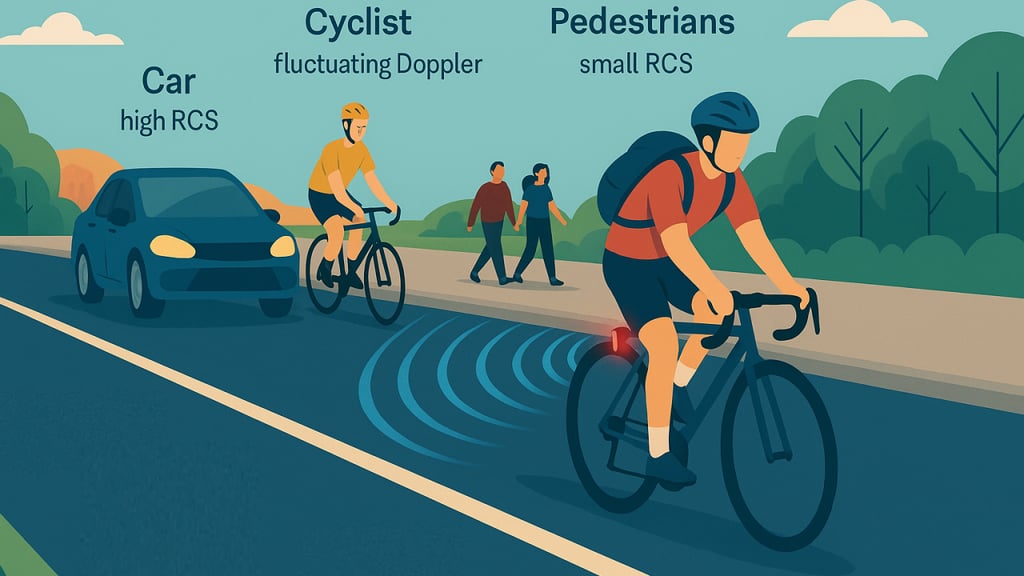
Cars: Their large metallic bodies shine brightly in radar’s eyes, creating a strong Radar Cross Section (RCS). They move with steady Doppler signatures — big and steady.
Cyclists: Smaller, with moving legs and spinning wheels, they generate medium but fluctuating RCS. Their Doppler signature dances with every pedal stroke — medium and fluctuating.
Pedestrians or Trees: Softer, quieter reflections. Small RCS, minimal Doppler shift — small and static.
By blending RCS, Doppler motion, range, and angle, radar pieces together not just that something is there, but what that something might be.
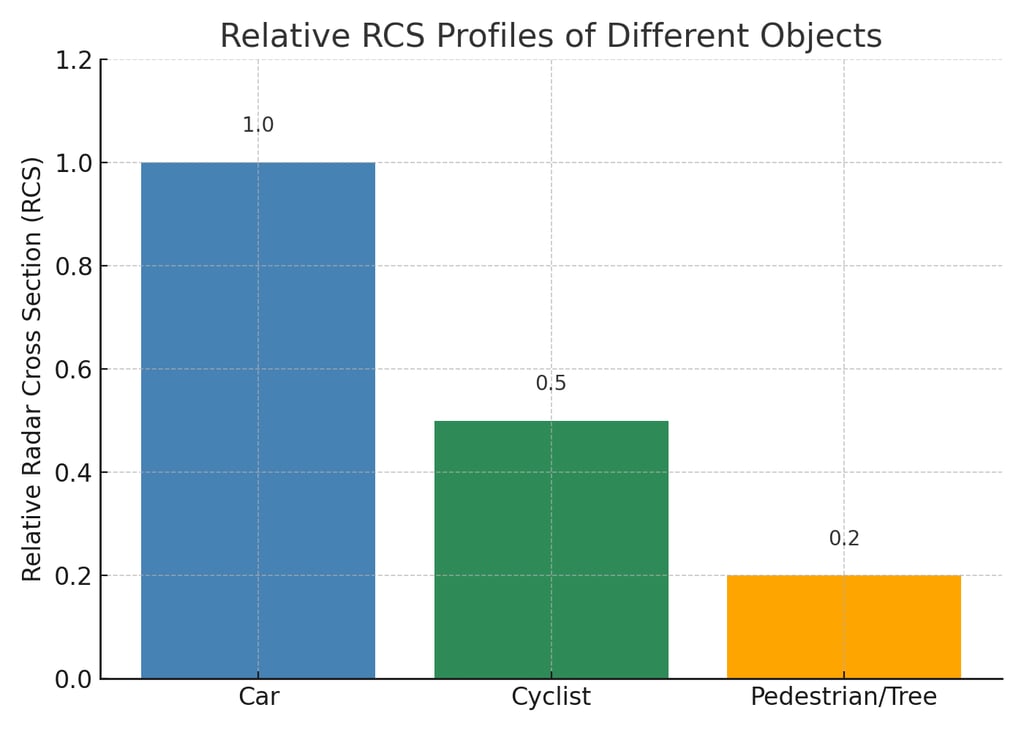
Relative RCS Profiles of different objects
🧠 The Role of AI
Rules like “big and steady = car” or “small and static = pedestrian” are useful, but the real magic begins when radar meets AI. With machine learning, radars can:
Recognize subtle patterns invisible to simple thresholds.
Reduce false alarms caused by roadside clutter.
Fuse with cameras to add a visual layer of intelligence.
This is the path toward radars that learn and adapt, becoming more reliable with every ride.
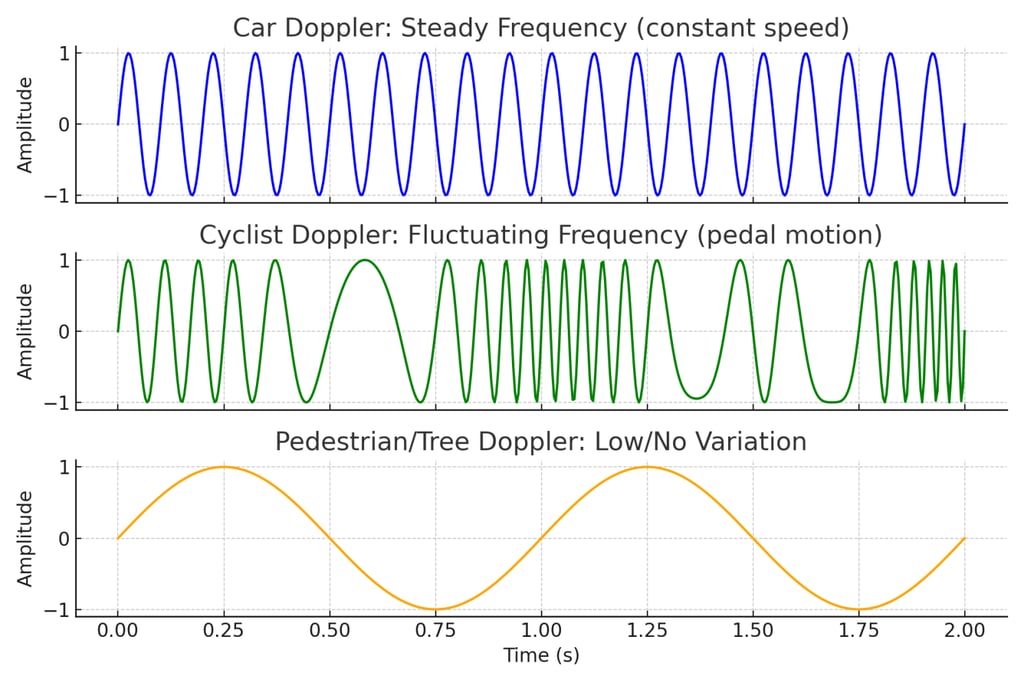
Doppler patterns
⚡ The Challenges We Face
But building a radar that sees like this isn’t easy. Engineers wrestle with:
Overlapping signals (a small car can look like a big bike).
Noisy environments (ghost echoes bouncing off buildings).
Tiny antennas (bike radars are the size of a light, not a car bumper).
Weather extremes (rain, fog, snow all blur radar’s vision).
Limited computing power (small SoCs must do the work of automotive-grade processors).
And perhaps the toughest challenge: training AI with enough diverse data — not just cars, but cyclists, pets, trees, and city clutter.
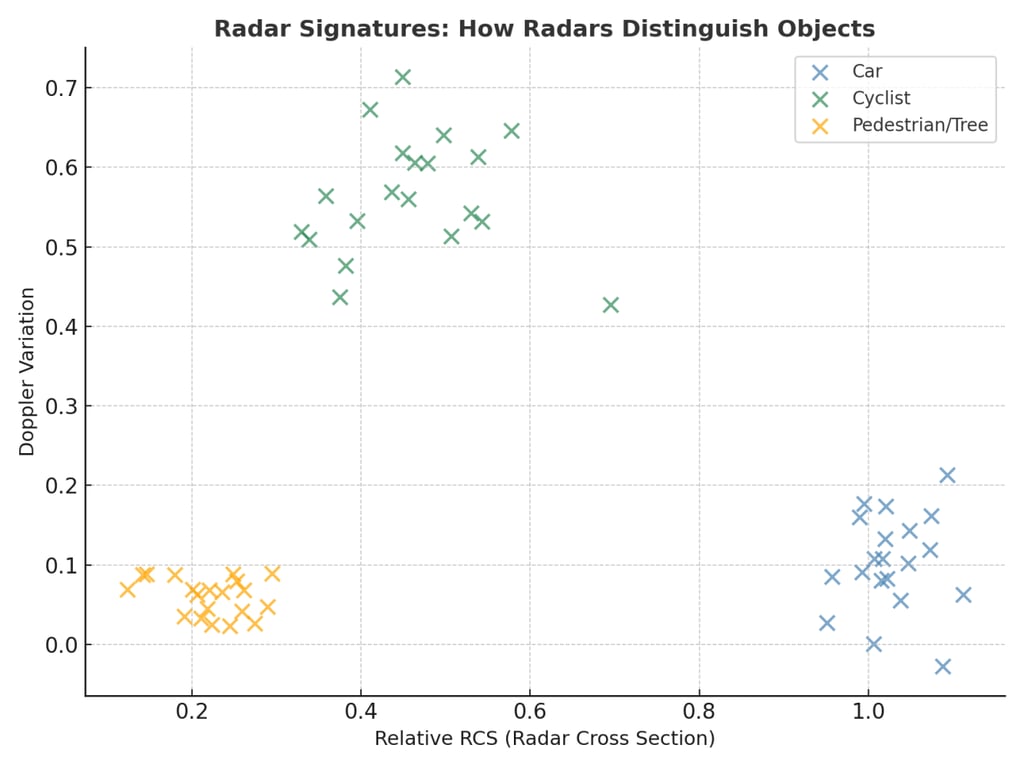
Radar Signatures
🌍 Why This Matters
Radar isn’t just another gadget. It’s a quiet guardian, helping cyclists feel safer on crowded roads and giving fleets, delivery services, and commuters peace of mind.
Every signal it interprets is a step toward fewer accidents, more confident rides, and smarter mobility.
The road ahead is clear: with innovation in AI, sensor fusion, and hardware design, tomorrow’s bicycle radar won’t just detect. It will understand.
✨ Final thought: Next time you clip in for a ride, imagine an invisible shield watching over you — listening to the world in radio waves, distinguishing cars from cyclists, motion from stillness, safety from risk. That’s the promise of radar, and it’s only getting smarter.